

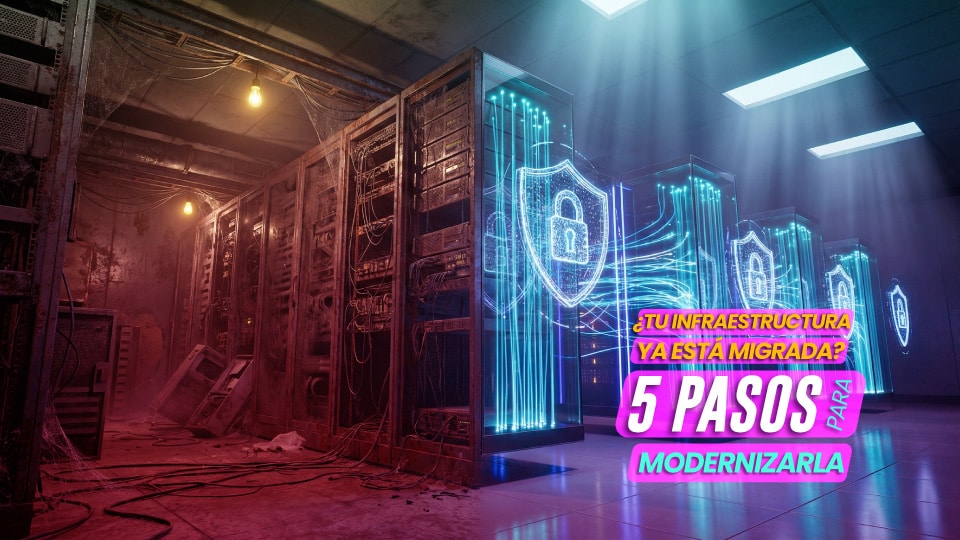
In a digital landscape where threats evolve faster than many technological infrastructures, one question emerges that no leadership team should ignore: Is our infrastructure truly migrated and prepared for the future?
The answer does not depend solely on tools or systems, but on the level of modernization of the protocols and standards that support the organization’s daily operations.
This analysis aims to highlight the essential elements that define a secure, modern, and market-aligned infrastructure.
1. Have we eliminated vulnerable legacy protocols?
The first step in assessing technological maturity is determining whether services still rely on obsolete protocols. Their presence indicates high exposure, as they are recurring targets in exploitation campaigns.
Protocols that must be removed immediately include:
- FTP
- Telnet
- SMBv1
- SNMPv1 and v2c
- TLS 1.0 / TLS 1.1
- Unencrypted HTTP in critical internal zones
The existence of any of these elements prevents the infrastructure from being considered ready to operate under modern security models.
2. Have we adopted modern protocols with strong encryption?
A future-ready infrastructure incorporates current standards that ensure integrity, authenticity, and confidentiality of traffic. Key examples include:
- TLS 1.3, which removes insecure ciphers and reduces latency
- HTTPS with HSTS policies, preventing downgrade attacks
- SSH v2,fully replacing plaintext access
- SFTP or FTPS, ideal for corporate file transfers
- SNMPv3with authentication and encryption
These protocols not only strengthen communication but also standardize uniform mechanisms for auditing and compliance.
3. Have we reduced and segmented port exposure?
Modernization is not limited to protocols; it also involves reorganizing how services are exposed.
Modern environments tend to consolidate services under secure ports such as:
- 443 (TLS/HTTPS/HTTP3)
- 853 (DNS-over-TLS)
- 51820 (WireGuard for modern VPNs)
Dangerous or frequently attacked ports—such as 21, 23, 445, 5900, or 3306—should be blocked, segmented, or encapsulated within internal networks with strict Zero Trust policies.
4. Are we using protocols that are Future-Ready?
Organizations aiming to ensure technological continuity must adopt the protocols that will become standard over the next five to ten years:
- HTTP/3 over QUIC, more efficient and resilient
- DNS-over-TLS and DNS-over-HTTPS improving privacy
- SMB-over-QUIC, a secure replacement for remote file access
- gRPC, optimizing microservices communication
- MQTT v5 over WebSockets, ideal for modern IoT
These mechanisms represent the natural evolution of digital infrastructure.
5. Is the Architecture already operating under Zero Trust principles?
Zero Trust is not a commercial buzzword; it is a structural strategy.
A future-ready architecture includes:
- Granular segmentation
- Continuous identity validation
- Least-privilege access policies
- Advanced monitoring
- Elimination of implicit trust
The infrastructure must not only be updated—it must be protected by models that anticipate anomalous behavior.
A Call to Action for Infrastructure Leaders
At this point, it’s no longer about evaluating technologies or considering a potential upgrade in the future; it’s about accepting a critical responsibility amid the exponential growth of digital threats.
Modernizing protocols, reducing exposed ports, and adopting robust standards can no longer be seen as secondary projects or optional improvements.
Invite your infrastructure leaders to take the next step: we are in a race against time where modernization is not a luxury but a requirement to ensure resilience and operational continuity.
Every minute an organization postpones its modernization decisions becomes an opportunity window for malicious actors, who already use advanced, automated, and highly specialized techniques.
Is your infrastructure Truly Prepared?
Answering this question honestly will help establish priorities, identify risks, and plan a comprehensive modernization process.
A migrated, segmented, and modern-standards-aligned infrastructure not only reduces threats—it also drives operational agility, stability, and competitiveness.
Modernization must not be seen as an expense, but as a strategic asset that protects continuity, reputation, and growth.