


In modern software development, speed of delivery is key—but security must not be left behind. This is where DevSecOps comes in: a practice that integrates security as an essential and continuous part of the development lifecycle, from design to operations.
It’s no longer about adding security controls at the end, but embedding them from the start—automated, collaborative, and continuous.
What is DevSecOps?
DevSecOps approach is the natural evolution of DevOps, where security (Sec) becomes an integral component alongside Development (Dev) and Operations (Ops). This methodology seeks to eliminate traditional silos between teams, promoting a unified workflow that supports agility without compromising cybersecurity..
DevSecOps enables early vulnerability detection, automation of security controls, cost reduction, and continuous protection in production environments.
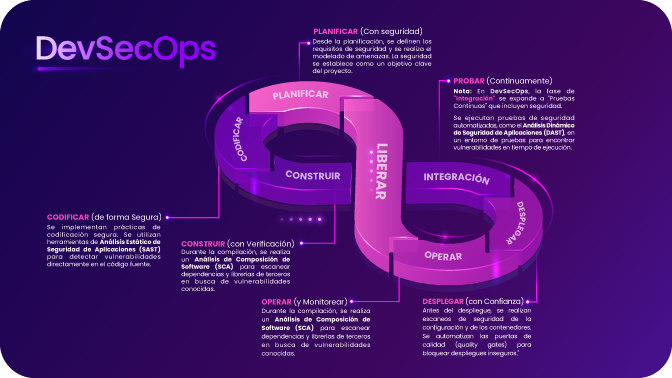
Origins and foundations of DevSecOps
DevSecOps emerged in response to:
- The need to anticipate security risks in fast-paced development cycles.
- Encouraging shared responsibility in software security.
- Implementing automated controls and continuous reviews.
- Maintaining agile delivery through collaborative tools and processes.
Key principles of DevSecOps
Shift Left Security .
Integrating security from the earliest stages of development helps identify and remediate vulnerabilities before they escalate, reducing both impact and cost.
Automation of Tests and Controls
Tools like SAST, DAST, IAST and RASP enable consistent, repeatable analyses without manual intervention, improving both efficiency and software quality.
Continuous Vulnerability Management
Constant, automated monitoring keeps environments updated, detects new threats, and enables proactive patching and mitigation.
How to Implement DevSecOps Step by Step
Implementing DevSecOps is not only a technical challenge—it also requires a cultural shift, clear processes, and the right tools..
1. Evaluate the Current State
- Diagnose your current processes and tools.
- Identify critical security points within your development lifecycle.
2. Foster a Culture of Shared Security
- Train all team members on cybersecurity best practices.
- Define security as a collective responsibility.
One of the most effective ways to strengthen this culture is by promoting real collaboration between developers and offensive cybersecurity specialists.When both work as allies — instead of in silos — vulnerability detection is accelerated and more resilient software is built from the start.
📖 If you want to dive deeper into how to achieve this approach, we recommend reading this article:
👉 Hackers and Developers: Allies for Secure Software
3. Integrate Automated Security Tools
- SAST: SonarQube, Checkmarx.
- DAST: OWASP ZAP, Burp Suite.
- IAST/RASP for real-time analysis.
- Dependency Scanning: Snyk, Dependabot.
- Security as Code: Terraform + Sentinel, OPA (Open Policy Agent).
4. Adapt Infrastructure and CI/CD Pipelines
- Secure every step of the pipeline: builds, tests, deployments.
- Version and audit your infrastructure as code.
5. Enable Real-Time Monitoring and Response
- Implement tools like Prometheus, Grafana, ELK.
- Define incident response plans.
6. Continuous Improvement with Clear Metrics
- Run retrospectives focused on security.
- Measure KPIs such as time to remediation, scan coverage, and incident counts.
+. Empowered Teams
- Appoint Security Champions in each team to lead secure practices and act as a bridge between development and security.
Tangible Benefits of DevSecOps Implementation
♾️ Early Vulnerability Detection
- Up to 50% lower remediation costs.
- Fewer incidents in production.
- Reduced impact on end users.
♾️ Increased Regulatory Compliance
- Automated reporting and traceability.
- Agile adaptation to new regulations.
- Simplified and more effective audits.
♾️ Improved Reputation and Trust
- Higher perceived security by users and stakeholders.
- Fewer public security incidents.
- Stronger market positioning.
♾️ Gradual and Controlled Implementation
- Start with pilot projects in critical areas.
- Define success metrics from the beginning.
- Scale based on real results.
♾️ Cross-Team Collaboration
- Clear communication channels.
- Defined roles and responsibilities.
- Spaces for ongoing feedback.
DevSecOps as a Modern Development Evolution
In conclusion, adopting DevSecOps is more than a technical decision—it’s a cultural shift that places security at the heart of the development cycle. This methodology not only improves security posture but also:
- Accelerates time to market.
- Reduces operational costs.
- Strengthens user trust.
In a world where threats evolve rapidly, organizations that embrace DevSecOps approach will be better equipped to innovate with security, speed, and confidence.
Is your MVP ready to launch… but also ready to withstand an attack?
Learn how to apply DevSecOps approach from day one and prevent your minimum viable product from becoming your greatest risk. 👉 Follow this link
But implementing DevSecOps approach isn’t just about automation and culture. It also requires validating —under real-world conditions—whether your infrastructure, code, and processes can withstand intelligent attacks.
At 7WAY Security, our Red Team helps you test your environment through advanced ethical hacking exercisesdesigned to simulate real-world attacks, uncover critical vulnerabilities, and provide you with technical evidence to improve.
🔎 Learn how our Ethical Hacking and Network Teaming services strengthen the maturity of your DevSecOps: 👉 Red Team | 7WAY SECURITY