

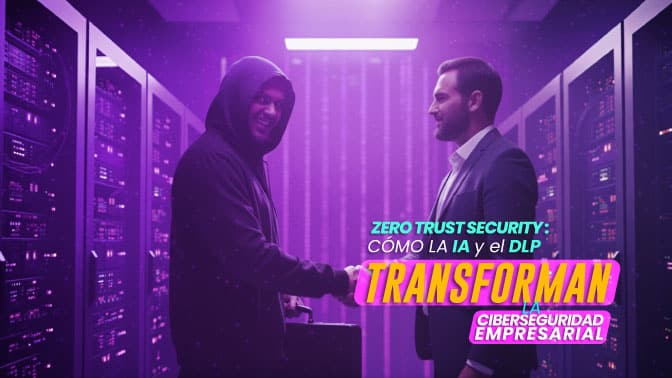
The model of Zero Trust Security was born in response to an unquestionable reality: internal and external threats can cross any perimeter. In a hyper-connected world, the traditional perimeter is blurring and the only sustainable strategy is to assume that nothing and no one is reliable by default.
But Zero Trust is not a final destination; it is an ongoing evolution. Frameworks such as the CISA Maturity Model offer clear steps toward that goal, and emerging technologies, especially the artificial intelligence and advanced data loss prevention (DLP) are redefining what it means to get to state Optimum.
The deep concept: more than access control
At its core, Zero Trust is a cultural and technical shift. It's not just about verifying identities or encrypting data, but about orchestrating an intelligent network where every access, every data flow and every application is under constant scrutiny, guided by three cross-cutting pillars:
- Visibility and analysis: knowing what, who and how interacts with the resources.
- Automation and orchestration: respond to events in milliseconds without human intervention.
- Dynamic governance: policies that adapt to risk and context in real time.
This implies that Zero Trust, at its highest level, not only protects, but also learns and adapts.
The end point: a smart, self-regulating ecosystem
In an Optimal state, the organization:
- It has dynamic and continuous inventory of identities, devices, networks, applications and data.
- Applies real-time access controls based on context, risk and behavior.
- Use full encryption (in transit, at rest and in use) with automatic key management.
- Implements total micro-segmentation and data flows controlled by self-adjusting policies.
- It monitors and correlates telemetry from the entire infrastructure to detect anomalies even before they have an impact.
This level is impossible to sustain with human intervention alone; this is where AI and evolved DLP are essential.
Role of Artificial Intelligence in Zero Trust
The AI extends Zero Trust's capabilities in several dimensions:
- Predictive analyticsAnticipates intrusion attempts by analyzing behavioral patterns and historical telemetry.
- Detection of unknown threats (zero-day) using deep learning algorithms trained to identify minimal deviations in traffic or credential usage.
- Adaptive authenticationAdjusts access requirements according to the risk detected, e.g., requesting reinforced MFA only when there are suspicious signals.
- Autonomous orchestrationThe system can make immediate decisions, such as isolating an endpoint or revoking compromised credentials, without waiting for an analyst to intervene.
In short, AI turns Zero Trust security into a digital nervous system able to react in real time and learn from every interaction.
Advanced DLP: intelligent data protection
At Zero Trust, the mainstay of Data is at its best with an AI-driven DLP:
- Automatic sorting and labelingidentifies sensitive data (PII, intellectual property, trade secrets) even when they change format or location.
- Contextual policiesBlock or allow transfers based on user, device, location and operational urgency.
- Persistent encryptionData travels and remains encrypted even outside the corporate environment, with keys linked to identity and context.
- Proactive leakage preventionAI detects unusual exfiltration behavior, such as large download volumes or use of unauthorized channels, and takes action within milliseconds.
This means that the DLP is no longer a simple filter, but rather a smart guard that understands the value and risk of each bit of information.
Integration of AI and DLP in Zero Trust maturity
In an optimal setting:
- Unified visibilityAI consolidates data from SIEM, EDR, network monitoring, identity management and DLP for a live risk map.
- Self-evolutionary policiesAccess, encryption and segmentation rules are automatically adjusted according to AI insights.
- Orchestrated responseDLP, upon detecting a risk, communicates with the access control system and the network to isolate the incident, block exfiltration and record evidence for forensic analysis.
- Continuous simulation of attacksAI runs automated tests to measure resilience and adjust defenses.
Mapping of Zero Trust with the 18 CIS Controls v8
- Inventory and Control of Enterprise Assets:
Inventory dynamic in real time; blocking of unauthorized or insecure devices. - Inventory and Control of Software Assets:
Software catalog linked to execution control; whitelisting and integrity validation. - Data Protection:
Comprehensive encryption and contextual DLP; granular control by data classification. - Secure Configuration of Enterprise Assets and Software:
Continuous hardening and automatic validation of configurations. - Account Management:
Centralized IAM, phishing-resistant MFA and automatic provisioning/de-provisioning. - Access Control Management:
Dynamic policies by context and risk; continuous authentication. - Continuous Vulnerability Management:
Constant scanning, risk-based prioritization and integration with threat intelligence. - Audit Log Management:
Immutable logs with AI analysis; SIEM/UEBA integration for automatic response. - Email and Web Browser Protections:
Remote isolation, advanced filtering and real-time analysis. - Malware Defenses:
Multi-layer protection with EDR and AI-driven sandbox analysis. - Data Recovery:
Encrypted and isolated backups; restore only with strong authentication. - Network Infrastructure Management:
Micro-segmentation and secure administration with rotated credentials. - Network Monitoring and Defense:
Complete visibility; behavioral analysis and automated blocking. - Security Awareness and Skills Training:
Continuous training adapted to the role; advanced phishing simulations. - Service Provider Management:
Restricted access to suppliers; strict monitoring and segmentation. - Application Software Security:
DevSecOps with code analysis, dependencies and pre-deployment validation. - Incident Response Management:
Automatic response orchestration; real-time forensic analysis. - Penetration Testing:
Continuous and automated testing; validation of segmentation and controls.
Where Zero Trust is evolving to
Over the next few years, Zero Trust will move towards a focus on Zero Cognitive Confidencewhere:
- Policies will be almost entirely AI-generated and tuned.
- The DLP will be integrated with threat intelligence to block threats before they arrive.
- The decentralized digital identity (blockchain) will reduce fraud and improve secure credential portability.
- Segmentation and encryption will be transparent to the user, without friction, while maintaining strict controls.
Want to test the security of your models and applications with AI? Find out how a specialized pentesting in artificial intelligence environments can help you identify vulnerabilities before attackers do. Visit this page and schedule your free diagnosis.
References: https://www.cisa.gov/sites/default/files/2024-05/zero_trust_maturity_model_v2_508%20%281%29_ES.pdf